Creating a restoration that looks natural on delivery day is only part of the challenge. Dentists also need materials capable of maintaining their appearance and function under years of occlusal forces. Zirconia has become an important restorative material because of its strength and versatility, but newer multi-layered formulations take the material a step further by incorporating variations in shade and translucency within a single disc or block.
These built-in transitions allow the restoration to reproduce some of the visual characteristics found in natural dentition without relying entirely on external characterization or extensive ceramic layering. For Panam Dental Lab, which receives restorative cases from dental teams in Savannah, GA, Houston, TX, Sandy, UT, and other communities, multi-layered zirconia provides another way to balance esthetic goals with the mechanical demands of everyday dentistry.
Understanding what happens within the material helps explain why multi-layered zirconia has become increasingly useful for crowns and bridges where both appearance and longevity matter.
Traditional monolithic zirconia is milled from a uniform zirconia disc or block. Although staining and glazing can create attractive results, the underlying material generally has consistent optical characteristics throughout the restoration.
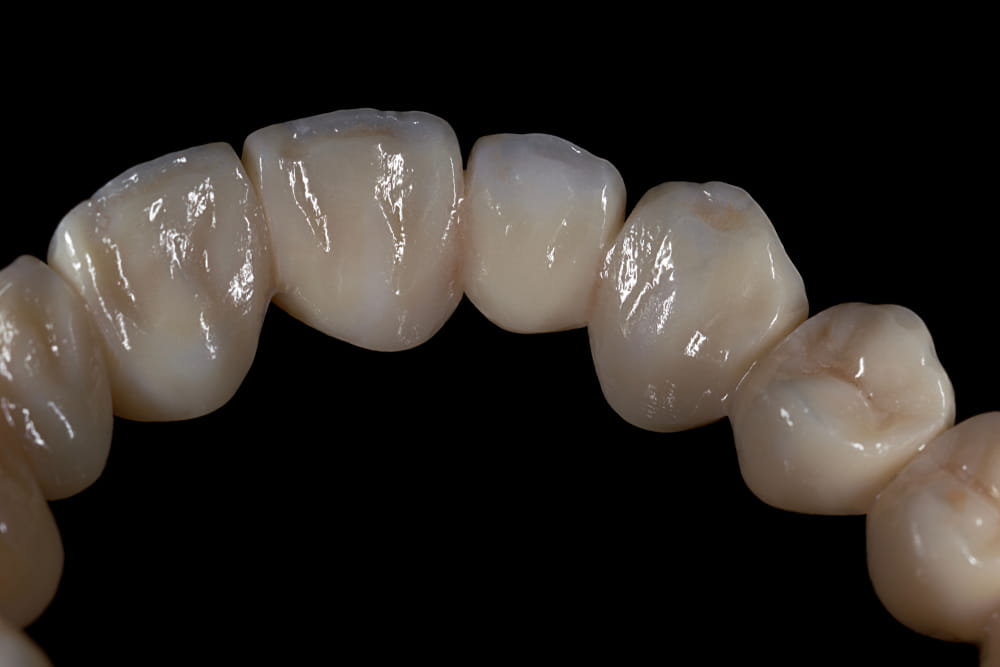
Multi-layered zirconia is engineered differently. The disc contains gradual transitions in shade, translucency, and, depending on the material system, mechanical properties. When the restoration is positioned strategically within the disc during CAD/CAM nesting, these layers can correspond with different areas of the final crown.
The cervical portion can have greater chroma and opacity, while the incisal or occlusal portion can exhibit greater translucency. Rather than creating an abrupt boundary between zones, modern materials are designed to produce a gradual transition.
This approach helps technicians create restorations that more closely resemble the optical gradient of a natural tooth.
Natural teeth are not uniformly opaque. Light interacts differently with enamel and dentin, creating variations in brightness, translucency, and color from the cervical area toward the incisal edge.
A restoration made from a highly uniform material may match the selected shade but still appear visually flat. Translucency gives light an opportunity to interact with the restoration rather than simply reflecting from its surface.
Multi-layered zirconia incorporates this variation into the restorative material itself. The result can provide greater depth and a more natural transition between the body and incisal portions of the crown.
This characteristic makes multi-layer zirconia particularly useful within fixed restoration workflows where the goal is to combine predictable strength with an appearance that integrates naturally with surrounding dentition.
One of the central challenges in zirconia development has been balancing translucency with mechanical strength. Increasing translucency often involves changes to the material’s composition and crystalline structure, and these changes can influence mechanical properties.
For that reason, not every zirconia formulation is interchangeable.
Different areas of the mouth experience different functional demands. A restoration for an anterior tooth may prioritize optical properties differently from a posterior crown exposed to substantial occlusal forces. Bridge span, connector dimensions, available restorative space, opposing dentition, and parafunctional habits can also influence material selection.
The advantage of modern zirconia systems is that clinicians and technicians have more options available. Instead of treating zirconia as one universal material, the restorative team can select a formulation appropriate for the clinical situation.
The visual effect of a multi-layer zirconia crown begins before milling. During digital design and nesting, the technician determines where the restoration should be positioned within the zirconia disc.
That position matters because moving the crown vertically within the material can change how the internal gradient appears in the finished restoration.
For example, positioning the restoration appropriately can allow the more chromatic region to influence the cervical portion while placing the translucent zone closer to the incisal edge. This can reduce the amount of external characterization necessary to achieve the desired effect.
The process still requires technical judgment. Tooth preparation, stump shade, restoration thickness, selected zirconia system, neighboring teeth, and final shade expectations all influence the outcome.
Traditional layered restorations may use a strong underlying framework covered by veneering ceramic to create the desired esthetics. This approach remains valuable in appropriate cases, especially when extensive characterization is required.
However, every additional material interface introduces another variable.
Monolithic multi-layer zirconia allows much of the restoration to remain a single material. Esthetic effects can be incorporated through the zirconia gradient, followed by selective staining, glazing, or limited characterization when appropriate.
Reducing dependence on extensive veneering may help minimize concerns associated with chipping or delamination of veneering ceramic. This does not make multi-layer zirconia immune to complications, but it can simplify the material structure while maintaining useful esthetic properties.
Advanced material technology cannot compensate for inappropriate case selection. The clinical situation should always determine whether a particular zirconia formulation is suitable.
Important considerations include:
This is one reason communication between the dental practice and laboratory remains important even as materials become more sophisticated. A technician who understands the clinical conditions can select and position the material more appropriately.
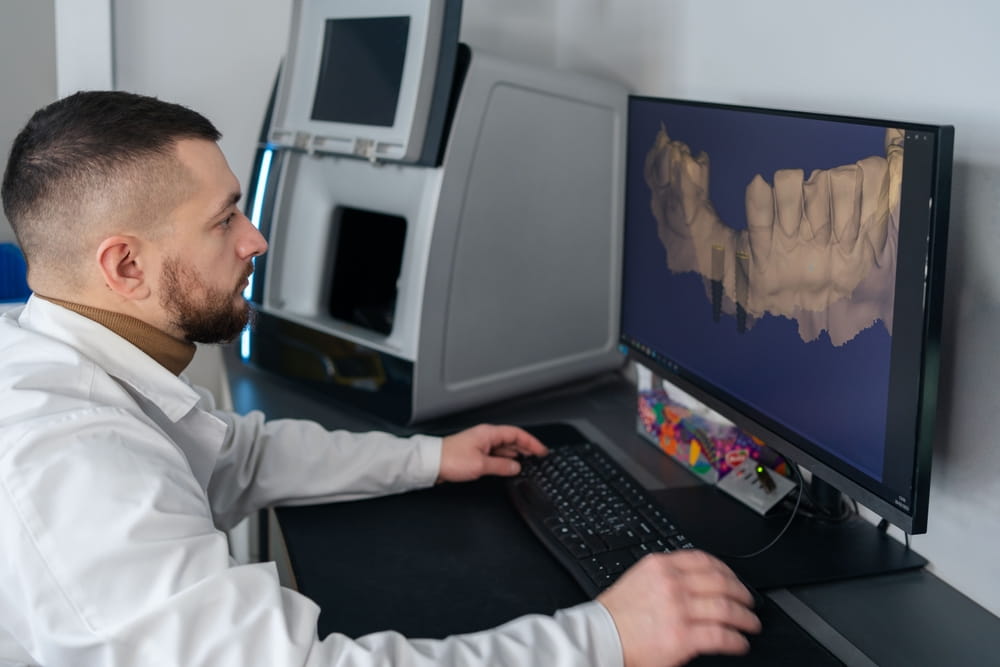
Multi-layered zirconia is particularly well suited to digital restorative workflows. CAD software allows technicians to control restoration anatomy, contacts, occlusion, thickness, and material positioning before the case enters production.
The digital design can then be nested within the selected portion of the zirconia disc to take advantage of its shade and translucency gradient.
Digital workflows are also valuable when restorative treatment involves implants. For implant restorations, factors such as abutment color, restorative thickness, emergence profile, and implant position may influence how zirconia appears in the final restoration.
Having detailed digital records gives the laboratory more information to consider when selecting and designing the restorative material.
The properties of the zirconia block are only one part of the final result. Finishing and polishing procedures also influence how the restoration performs.
Occlusal adjustments may sometimes be necessary after try-in. When zirconia is adjusted, proper polishing is important for restoring a smooth surface. A rough surface can increase wear against opposing dentition and compromise the carefully finished restoration.
Following appropriate polishing protocols after adjustment helps maintain surface quality. Glazing and characterization must also be performed according to the manufacturer’s recommended procedures.
Long-term esthetic performance therefore depends on both the material itself and the way the restoration is fabricated, adjusted, and maintained.
Multi-layer technology can improve the optical characteristics of zirconia, but accurate shade communication remains critical.
Clinical photographs, shade tabs, preparation shade information, and descriptions of neighboring teeth can provide useful context. For anterior cases, details such as translucency, incisal effects, surface texture, and characterization may be just as important as the basic shade designation.
Digital photographs can be particularly useful because they allow the technician to evaluate characteristics that may not be communicated by a shade prescription alone.
This same attention to restorative planning can be important when treatment combines fixed prosthetics with removable restorations, where shade and tooth characteristics may need to remain visually consistent across different prosthetic materials.
Multi-layered zirconia demonstrates how restorative materials are evolving beyond the traditional choice between strength and appearance. By incorporating controlled gradients of shade and translucency within the material, manufacturers can give technicians a stronger foundation for creating restorations with greater visual depth.
The technology does not remove the importance of preparation design, material selection, shade communication, occlusal management, or laboratory expertise. Instead, it provides another tool for bringing those elements together.
For dental practices in Savannah, GA, Houston, TX, and Sandy, UT, working with Panam Dental Lab, multi-layer zirconia provides a practical way to balance natural esthetics with the strength required for long-term function. With thoughtful material selection and precise positioning within the zirconia disc, restorations can achieve gradual transitions in shade and translucency while maintaining the durability expected from modern zirconia.
Zhang Y, Lawn BR. Novel zirconia materials in dentistry. Journal of Dental Research.
Stawarczyk B, Keul C, Eichberger M, Figge D, Edelhoff D, Lümkemann N. Three generations of zirconia: From veneered to monolithic. Dental Materials.
American College of Prosthodontists. Dental restorative materials and prosthodontic treatment information.